
How to Build an Industrial Steel & Solid Wood Dining Table
Table of Contents
- 1. Sizing, Proportions & Structural Load Engineering
- 2. Selecting the Steel Base Profile: Spider vs. Trapezoid vs. U-Frame
- 3. Choosing Timber Slabs: Suar Wood, American Walnut & White Oak
- 4. The Critical Rule: Allowing for Wood Movement with Slotted Holes
- 5. Recommended Threaded Inserts & Hardware
- 6. Order Custom Welded Table Bases From Our Workshop
1. Sizing, Proportions & Structural Load Engineering
Combining cold-rolled structural steel with organic solid wood is the cornerstone of modern industrial dining furniture. However, a 6-to-8-seater solid hardwood slab can weigh anywhere from 60kg to 120kg.
To prevent bowing and table rocking, your steel base must be engineered with appropriate hollow structural section (HSS) tube wall thickness (minimum 2.0mm to 3.0mm wall) and a standard dining height of 720mm to 750mm.
2. Selecting the Steel Base Profile: Spider vs. Trapezoid vs. U-Frame
Different metal frame geometries offer distinct aesthetic and seating clearance advantages:
- Spider / Mikado Base: Four angled steel tubes intersect at a central apex. Ideal for round or rectangular tables because diners have zero leg interference on the sides or table ends.
- Trapezoid & Tapered A-Frames: Taper inward toward the top, lending a mid-century industrial feel with massive lateral stability.
- Square U-Frames & Loop Legs: Minimalist and contemporary, best suited for minimalist modern apartments and live-edge suar slabs.
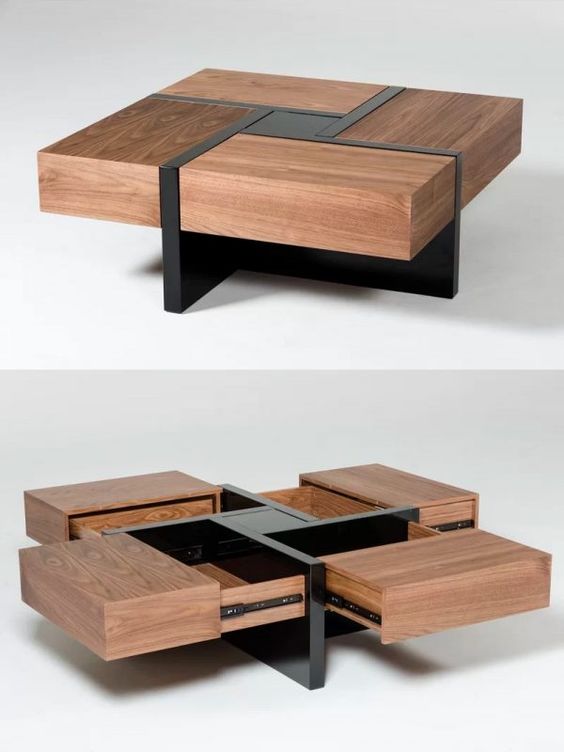
Heavy-Duty Industrial Steel T-Shape Table Legs (Set of 2)
Pre-drilled mounting plates with slotted expansion holes. Rated for over 400kg load capacity, finished in matte black electrostatic powder coating.
Check Price on Amazon →3. Choosing Timber Slabs: Suar Wood, American Walnut & White Oak
In Southeast Asia, Suar Wood (Rain Tree) is celebrated for its dramatic interlocking grain and single-slab live edges. For contemporary Scandinavian and Japandi aesthetics, kiln-dried American Black Walnut and FAS White Oak offer unmatched refinement when paired with powder-coated black or brass-accented metal.
4. The Critical Rule: Allowing for Wood Movement with Slotted Holes
The #1 mistake DIYers make is bolting wood tightly through circular holes in rigid steel. As relative humidity fluctuates, solid wood expands and contracts across its grain width by up to 5mm–10mm.
The Solution: Your steel top mounting plates must feature elongated slotted holes (15mm x 8mm). Fasteners should be fitted with rubber or nylon washers and tightened just snug enough to allow the tabletop to glide horizontally during seasonal changes without splitting.
5. Recommended Threaded Inserts & Hardware
Never use coarse drywall screws to attach heavy table legs. Instead, install brass or zinc-alloy threaded inserts (M8 / 5/16") into the underside of the wood slab. This allows you to disassemble the table repeatedly without stripping wood fibers.
E-Z Lok Threaded Insert Kit for Hardwood (M8 / 50-Piece)
High-tensile brass threaded inserts with hex drive for clean, flush mounting in solid timber. Eliminates stripped wood screws permanently.
Check Price on Amazon →